Exciting Businesses Fail. Boring Ones Get Paid.
Australian trade businesses rarely fail because the owner had a bad idea. They fail because nobody did the boring work.
That is the clearest pattern across hundreds of engagements, in trades, allied health, professional services and not-for-profits. The boring business fundamentals are what decide it. It holds at $180,000 turnover. It holds at $40 million. The uniforms change. The vocabulary changes. The machinery underneath stays identical.
Here is the point, and it is the whole point. The boring business fundamentals decide whether your business survives. The exciting parts only decide how much you enjoy it.
Four boring fundamentals carry every business:
- Not profit. Cash. Profit is a judgment call involving accruals, timing and an accountant with a view. Cash is whether the money is in the account on Friday.
- Who they are, what they pay, and whether you chose them or they chose you.
- Whether the work survives someone taking annual leave.
- Whether decisions get made, dated and done.
Almost every urgent job we get called into involves a business that was profitable on paper. It had an earnings statement to be proud of and an empty bank account. That is a timing failure, not a trading failure. Timing kills quietly, because it does not appear in the report you like reading.
The exciting version of business is the growth spurt, the rebrand, the new software, the big job. The boring version is a cash flow forecast, a pricing review, a documented process and a monthly hour where somebody asks what actually moved. Growth is genuinely exciting. It is also an amplifier. It magnifies whatever you already are, and that includes the cracks. Fix the crack, then add the storey in that order.
None of the boring business fundamentals are complicated. That is exactly why they get skipped. The boring business fundamentals feel optional right up until the month they are not.
If you take one action from this article, take this one. Pick the single dullest task you have been avoiding: the pricing review, the cash flow forecast, the process you keep meaning to write down. Book ninety minutes for it this month. Put it in the calendar with a date, because a decision without a date is a preference. That is the entire method. It is unglamorous, and it works.
Free Resource: The Boring Basics Business Health Check
That is the core message. Everything below is depth, evidence and nuance. Read on if you want the proof.
Digging Deeper
The Numbers Behind the Pattern
Australia had 2,729,648 actively trading businesses at 30 June 2025. Small businesses with fewer than 20 employees made up 97.3 per cent of them. Roughly 63.6 per cent had no employees at all.
The churn is the part that surprises people. In 2024-25, 437,150 businesses started trading. In the same year, 370,500 stopped. That is over 800,000 businesses entering or leaving the market in twelve months.
Survival splits along an instructive line. Employing businesses show a three-year survival rate of about 61 per cent. Non-employing businesses sit closer to 43 per cent. One plausible reason is uncomfortable: hiring someone forces you to build systems, run payroll, document processes, and meet obligations on a schedule. Employers get dragged into the boring business fundamentals whether they like it or not. Sole operators can avoid them for years, and many do.
For trades specifically, the picture is sharper. Construction accounts for roughly 27 per cent of all company insolvencies in Australia, more than any other industry. In the twelve months to March 2025, 2,636 construction companies became insolvent for the first time, up 23 per cent year on year. More than three-quarters of construction firms entering insolvency had fewer than 19 full-time employees.
These businesses were not short of work. Australian construction recorded small business sales growth of 10.4 per cent year on year in the March quarter 2026, one of the strongest results of any sector. Busy and broke is a real state. It is the most common state we find, and it is a boring fundamentals problem rather than a sales problem.
Profit is exciting. Cash is a fact.
Profit is the number you mention at a barbecue. Cash is a Friday.
The gap between the two is measured in days, and in Australia, the days are getting counted properly now. In the March quarter 2026, Australian small businesses waited an average of 24.1 days to be paid after issuing an invoice. Invoices were settled an average of 6.9 days past their due date. The December 2025 quarter recorded 23.9 days, the fastest since tracking began in 2017.
Progress, then. A 6.9-day average lateness on a 14-day invoice means you are financing your customer for an extra 50 per cent of your stated term, on every job, forever.
The cost is measurable. Xero research surveying 500 employing Australian small businesses found they lost an average of $15,257 over the last financial year to late customer payments. More than half, 58 per cent, named customer payments as their single biggest cash flow challenge.
The power imbalance is real and documented. Payment disputes now account for around 42 per cent of all assistance requests to the Australian Small Business and Family Enterprise Ombudsman, well above the historical average of about 26 per cent. Large business payment performance has shown little material improvement since the Payment Times Reporting Scheme began.
So yes, some of this is genuinely done to you, and no amount of boring business fundamentals makes a large customer pay faster. Chase it, use the register, price the risk in. But the boring business fundamentals still apply, because the part you control is the forecast. If you know your cash position thirteen weeks out, a late payment is an inconvenience. If you do not, it is an event.
Where pricing actually breaks
We used to say pricing was a confidence problem wearing a spreadsheet costume. That the maths was fine, and the owner simply would not have the conversation.
That was wrong, and we have stopped saying it.
Plenty of pricing is genuinely broken at the maths. The costing is wrong. The charge-out rate does not cover wages, on-costs, overheads, tools, vehicle, insurance, admin time and a margin. The numbers do not work.
But look at why they stay wrong. Somebody sat down. Somebody did the sums properly. The sums came back and said: you are underpriced. And they did not believe it. Not because they cannot add up. Because they were frightened the market would not wear the real number.
Underpricing is not a costing error. It is a failure to believe the costing error. You found the truth, and you flinched.
The current environment makes the flinch feel rational. Businesses report that weak demand has limited their ability to pass on cost increases, with long contracts and lags between quoting and delivery making it worse. Rising costs remain the single biggest challenge small businesses name. Roughly half of Australians now say they support small businesses only if they can afford it. Everything in the air tells you to hold the price.
Here is what the exciting approach looks like: trust your gut, hold the rate, and hope volume fixes it. Volume does not fix it. Volume gets you more of the wrong price, faster, and it fills your calendar with the customers who value you least. Sustained underpricing also shapes who you attract. Price well below market, and you draw price-sensitive customers who leave the moment someone cheaper appears.
The boring business fundamentals approach: do the costing properly. Believe it. Then test the market. Quietly, on one client, and find out what actually happens.
Hardly anyone tests. They decide the answer is no on behalf of a market they have not asked.
Growth is the amplifier, not the fix.
“We’ll sort that out once we’re bigger” is the most common thing we hear, and it is always said with enormous optimism.
Whatever is mildly annoying at $500,000 is properly painful at $2 million and a crisis at $5 million. By the time you are bigger, the broken thing costs eleven times more to fix, and three people have built their careers on top of it.
This matters more in trades than most sectors, because construction is structurally fragile. The industry is fragmented and dominated by small operators, with mismatched timing between income and liabilities, and subcontracting everywhere. Growth in that structure does not create a buffer. It creates exposure. Each new job is more materials bought upfront, more wages paid before payment lands, more working capital tied up in someone else’s payment terms.
Boring growth means you apply the boring business fundamentals first, and fix the cash timing before you take the bigger contract. It is nowhere near as much fun. It works considerably better.
Systems beat heroics
Every business has a hero. You know who yours is. They stay back. They know where everything is. They are the reason last quarter did not fall over.
They are also an unfunded liability wearing a lanyard. A hero is a single point of failure with a good attitude, and you are one resignation away from a very bad quarter.
This is not an abstract risk. Around 45 per cent of Australian business owners have considered stepping away due to burnout or workload pressure. When the hero is the owner, and the owner is exhausted, the business has a continuity problem that it has not written down anywhere.
The job is not to find better people. It is to build something ordinary people can run well on an ordinary Tuesday. Documented process. Clear ownership. A rhythm that survives annual leave. These are the least glamorous of the boring fundamentals, and none of them will make a good story at a barbecue. All of it will still be standing when the hero takes long service leave.
Governance is not a big-business luxury
Governance is easily the most boring word in this article. Of all the boring business fundamentals, it is the one that owners skip first. That is precisely why it works.
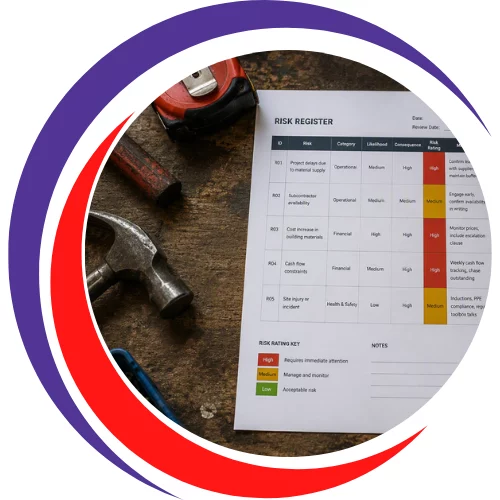
We review a lot of governance, so this next part is not a cheap shot. We have seen micro businesses with a one-page risk register and a habit of writing down why they decided things. That is governance. It is real, it gets used, and everyone in the business could tell you what is on it.
We have also seen large organisations with a board, a charter, and a policy suite so comprehensive that it has its own filing cabinet. Beautiful documents. Last opened during a different Prime Minister.
Governance is not paperwork. It is whether you can explain how you decided. You can do that on one page, today, for nothing. If your risk register only exists because somebody asked for it, it is not a risk register. It is homework.
Why implementation is rare
Here is the most damning statistic we found, and it explains this entire article better than we can.
Payday Super commenced on 1 July 2026. Superannuation must now be paid with every pay run rather than quarterly, reaching the employee’s fund within seven business days. It removes a working capital buffer that Australian employers have relied on for three decades.
Before it landed, research from the ScotPac SME Growth Index found that 88 per cent of SMEs reported some understanding of the change. And 68 per cent had made no cash flow preparations at all. Among micro-SMEs, 78 per cent had not acted. One in five were considering reducing headcount to manage the pressure.
Read those numbers again. Awareness was almost universal. Action was rare.
That is the whole problem in one dataset. The information was free, public and repeated for a year. Knowing was not the constraint. Doing was. Advice is abundant in this country. Implementation is vanishingly rare. The boring business fundamentals live entirely on the implementation side of that line, which is why knowing about them changes nothing on its own.
The best predictor of whether a client succeeds is not how clever their strategy was. It is whether anyone holds a rhythm to actually do it. That is turning up, same day, every month, and asking what moved. It is deeply unglamorous. It works nearly every time.
The Australian context in July 2026
The boring business fundamentals matter more right now than they have in years, because several things landed at once.
- Payday Super started 1 July 2026. The quarterly float is gone. The ATO’s Small Business Superannuation Clearing House closed on 30 June 2026.
- The RBA cash rate sits at 4.35 per cent, held on 16 June 2026 after three increases since the start of the year. Financial conditions have tightened.
- Inflation remains too high, driven partly by capacity pressures and partly by an oil supply disruption stemming from conflict in the Middle East.
- The national minimum wage rose 4.75 per cent from 1 July 2026.
- The $20,000 instant asset write-off threshold dropped from 1 July 2026.
- Card surcharging changes take effect from 1 October 2026, removing an option some businesses use to recover payment costs.
Xero research found that almost one in three small business owners expected to dip into personal savings to meet Payday Super obligations. Some 41 per cent planned to delay paying business expenses, and 38 per cent planned to delay paying themselves. Around 82 per cent said they would delay or reduce investment and growth plans.
Confidence reflects it. Of eleven markets surveyed by CPA Australia, Australian small businesses were the least likely to expect economic growth in 2026. Only 53 per cent expected to grow, against a survey average of 70 per cent.
This is a cash timing environment. Which is to say, it is a boring business fundamentals environment. The owners who come through cleanly will be the ones who modelled the gap in April, not the ones who panicked in August.
The global influences reaching your ute
None of this is purely domestic, and that is worth saying plainly to anyone who feels their local trade business is insulated from world events.
The fuel price you paid this morning traces back to a global oil supply disruption. That fuel price feeds directly into inflation, which feeds into the RBA’s decision, which feeds into your overdraft rate and your customers’ mortgage repayments, which feeds into whether they proceed with the job. Higher fuel prices are also passing through to the prices of other goods and services, which means your materials.
A conflict on the other side of the world reaches your business through four steps. You cannot influence any of them. You can only control your cash position, your price and your cost base. Global forces set the weather. The boring business fundamentals decide whether your roof holds.
The one real difference between small and large
Nine of the ten patterns we see scale perfectly. The boring business fundamentals of cash, pricing, systems, governance and cadence behave the same at every size. One thing does not.
Only micro and small businesses seem to mean it when it comes to community genuinely.
The evidence supports it more than we expected. Australian businesses gave $17.5 billion to charities and not-for-profits in 2015-16. Large businesses contributed $9 billion. Small and medium enterprises contributed $8.5 billion, nearly half the total, from a base of far smaller individual businesses. Around 70 per cent of SMEs contributed.
The interesting part is the stated reason. Small businesses most often cite a desire to give back to the community in which they operate and profit. For large businesses and corporations, deliberate strategy drove the choice of giving vehicles and modes.
That is the difference in a sentence. Down here, it is an instinct. Up there, it is a channel.
To be fair, because this is not a cheap shot, the large ones give more money and reach more people. They also run the formal infrastructure, with 63 per cent of large companies operating a workplace volunteering program against 6 per cent of small businesses. Many small businesses said they would like to get involved, but lack the machinery.
But the small operator sponsors the under-nines because their neighbour asked, and their kid is in the team, and it was forty bucks and a Saturday. It is rarely photographed. It is rarely published. There is no reporting line.
Both versions do good. Only one of them would still do it if nobody were watching.
If that describes you, protect it. It is the best thing about your business, and it is the one thing on this list that does not scale.
Where to start with the boring business fundamentals
The boring business fundamentals do not require a transformation. They require one dull thing, done, with a date on it.
- This month: build a thirteen-week cash flow forecast. Not a budget. A forecast of what actually lands and leaves, week by week. Model your Payday Super impact inside it.
- This quarter: review one price. Cost it properly, including your own time and overheads. Believe the number. Then test it on one client.
- This quarter: write down the one process that currently lives only in someone’s head. One page is enough.
- This year: build a one-page risk register. What could hurt us, how likely is it, and what are we doing about it? Review it because it is useful, not because someone asked.
- Every month: book one hour with someone who will ask what moved. That someone can be an adviser, a peer or a mentor. What matters is that the hour exists and recurs.
That is it. That is the whole method behind the boring fundamentals. Find the point, do the dull work, keep a rhythm.
The boring business fundamentals are boring precisely because they are known. Nobody in Australian business is failing for lack of information. They are failing for lack of a Tuesday afternoon and a decision with a date attached.
You are brilliant at the thing you do. That part is yours, and it should stay yours. We do the boring so you can be amazing.
If any of this sounds like your business, we should talk. Book a conversation to find out which of the boring business fundamentals is quietly costing you the most, and we will tell you honestly whether you need us or a spreadsheet and a deadline. You can also learn more about how we work, who we work with, and why we are so comfortable being the dull ones in the room at https://sbaas.com.au/about-us/.

Sources
Accounting Times. (2025). Construction and hospitality insolvencies continue to climb: ASIC. https://www.accountingtimes.com.au/economy/construction-and-hospitality-insolvencies-continue-to-climb-asic
Australian Bureau of Statistics. (2025). Counts of Australian businesses, including entries and exits, July 2021 to June 2025. https://www.abs.gov.au/statistics/economy/business-indicators/counts-australian-businesses-including-entries-and-exits/latest-release
Australian Securities and Investments Commission. (2024). Annual ASIC insolvency data reveals an increase in companies failing. https://www.asic.gov.au/about-asic/news-centre/news-items/annual-asic-insolvency-data-reveals-increase-in-companies-failing/
Australian Securities and Investments Commission. (2025). Insolvency statistics. https://www.asic.gov.au/about-asic/corporate-publications/statistics/insolvency-statistics/
Australian Small Business and Family Enterprise Ombudsman. (2024). Big businesses urged to “lift their game” on payment times. https://www.asbfeo.gov.au/media-centre/media-releases/big-businesses-urged-lift-their-game-payment-times
Australian Small Business and Family Enterprise Ombudsman. (2025). Payment Times Reporting Scheme. https://www.asbfeo.gov.au/resources-tools-centre/more-tools-and-resources/payment-times-reporting-scheme
Burns, W., Wang, S., Scaife, W., & Arias, D. (2017). Giving Australia 2016: Business giving and volunteering. Centre for Corporate Public Affairs, Australian Centre for Philanthropy and Nonprofit Studies, and Centre for Social Impact Swinburne. https://eprints.qut.edu.au/101307/
Commonwealth Bank of Australia. (2026). What small businesses need to know about Payday Super. https://www.commbank.com.au/articles/newsroom/2026/05/what-small-businesses-need-to-know-about-payday-super.html
Community Business Partnership. (2016). Giving Australia 2016 launched. https://www.communitybusinesspartnership.gov.au/giving-australia-2016-launched/
CPA Australia. (2026). CPA Australia Asia-Pacific small business survey 2025-26: Australia market summary. https://www.cpaaustralia.com.au/-/media/project/cpa/corporate/documents/tools-and-resources/business-management/small-business-survey/2025-2026-market-summaries/sbs—australia-market-summary-2025-26.pdf
NSW Small Business Commissioner. (2026). Payday superannuation: What small businesses need to know ahead of 1 July 2026. https://www.smallbusiness.nsw.gov.au/news-podcasts/news/payday-superannuation-what-small-businesses-need-to-know-ahead-of-1-july-2026
Payment Times Reporting Scheme. (2025). Helping small business. https://paymenttimes.gov.au/small-business/helping-small-business
Reserve Bank of Australia. (2025). Small business economic and financial conditions. RBA Bulletin, October 2025. https://www.rba.gov.au/publications/bulletin/2025/oct/small-business-economic-and-financial-conditions.html
Reserve Bank of Australia. (2026). Statement by the Monetary Policy Board: Monetary policy decision, 16 June 2026. https://www.rba.gov.au/media-releases/2026/mr-26-15.html
ScotPac. (2026). Payday Super looms as unprepared SMEs face cash flow strain. https://www.scotpac.com.au/media-releases/media-release-payday-super-looms-as-unprepared-smes-grapple-with-rising-costs-and-cash-flow-strain/
SmartCompany. (2026). The compliance crunch facing small businesses this July. https://www.smartcompany.com.au/business-advice/compliance-crunch-facing-small-businesses-july-payday-super/
Xero. (2026). Australian small business insights: March quarter 2026. https://www.xero.com/us/resources/small-business-insights/latest-australia/
Xero. (2026). Small businesses back Payday Super but late payments are a major compliance barrier. https://www.xero.com/uk/media-releases/small-businesses-back-payday-super-but-late-payments-are-major-compliance-barrier/
Xero. (2026). Small businesses getting paid quicker, but still late. https://blog.xero.com/data-insights/small-business-insights-data-late-payment-results/
Eric Allgood is the Managing Director of SBAAS and brings over two decades of experience in corporate guidance, with a focus on governance and risk, crisis management, industrial relations, and sustainability.
He founded SBAAS in 2019 to extend his corporate strategies to small businesses, quickly becoming a vital support. His background in IR, governance and risk management, combined with his crisis management skills, has enabled businesses to navigate challenges effectively.
Eric’s commitment to sustainability shapes his approach to fostering inclusive and ethical practices within organisations. His strategic acumen and dedication to sustainable growth have positioned SBAAS as a leader in supporting small businesses through integrity and resilience.
Qualifications:
- Master of Business Law
- MBA (USA)
- Graduate Certificate of Business Administration
- Graduate Certificate of Training and Development
- Diploma of Psychology (University of Warwickshire)
- Bachelor of Applied Management
Memberships:
- Small Business Association of Australia –
International Think Tank Member and Sponsor - Australian Institute of Company Directors – MAICD
- Institute of Community Directors Australia – ICDA
- Australian Human Resource Institute – CAHRI
Our Consulting Services
Management Consulting
Compliance & Risk
Professional Writing Services
Consistency in Communication
Small Business Consulting
Sustainable Businesses
Start-ups
Set-up for Success
Further Reading

Exciting Businesses Fail. Boring Ones Get Paid.
Australian trade businesses rarely collapse because the owner had a bad idea. They collapse because nobody did the boring work. Construction now accounts for around 27 per cent of all company insolvencies in Australia, and the pattern behind those failures is identical whether a business turns over $180,000 or $40 million. Same four levers. Same failure points. Same three excuses. Here is what hundreds of engagements reveal about the boring business fundamentals that decide who survives.

If You Stopped Tomorrow, Would the Business Survive Without You?
Many owner-led businesses do not survive their founder’s exit because the knowledge, relationships and decisions all sit in one person’s head. Succession planning turns that fragile structure into a transferable business that can keep running, be sold, or be handed on when the owner steps away.

When the Next Shock Hits, Will Your Practice Freeze or Pull Ahead?
Disruption is constant, but resilient practices do more than survive. They use cash buffers, reduced dependency, protected data and practical contingency planning to keep serving patients while less prepared competitors stall. For allied health practices, resilience is both risk management and growth strategy.

You Can’t Control the Economy. You Can Stop It Controlling You.
The economy feels like a force outside your control, up one year and down the next. It is, but that does not mean it gets to run your business. This guide breaks down the macroeconomic indicators that actually matter for Australian small business owners, and shows how your own records turn the headlines into confident decisions.

When Things Go Wrong, They Ask for the Policy You Never Wrote.
Professional policy and procedure writing turns Australia’s fast-changing rules into clear documents your team follows and a regulator accepts. Learn what a professional delivers, why it matters for allied health, trades, professional services and not-for-profits, and how to tell a real safeguard from a folder nobody reads.

Your Next Customer Might Ask AI, Not Google. Will It Recommend You?
Australians are starting to ask AI for a recommendation before they ever see a list of websites. Here is what that means for your trade business, and the proven basics that decide whether AI puts you forward.