



Digital Transformation Without the Hype: Roadmaps That Pay Back
Margins are tight. Input costs shift quickly. Customer expectations increase every quarter. Many leaders feel pressure to “go digital” fast. Rushed projects burn time and cash. What works is a focused roadmap that connects technology to priority processes and proves value early.
This guide sets out a practical approach to digital transformation for SMEs. It shows how to pick high-value processes, compare tools on what matters, stage a pilot, and track adoption and ROI. The principles apply to family businesses, growing firms, and mid-market enterprises across Australia. The result is digital transformation for SMEs that delivers cash flow benefits, not hype. When you anchor change to operations and people, digital transformation for SMEs becomes manageable and repeatable.
Why digitisation fails and how to avoid it
Digital projects stumble for predictable reasons. Most are avoidable.
Common failure patterns:
- Vague goals that do not link to a business outcome
- Automating a broken process instead of fixing it
- Tool selection driven by demos, not requirements
- No owner for benefits, adoption or data quality
- Training treated as a one-off event
- Weak change controls and no feedback loop
How to avoid them:
- Tie every initiative to a specific metric. For example, reduce quote-to-cash days by 20 per cent.
- Map the current process. Remove steps that add no value. Then design the future flow.
- Choose tools only after you document must-have capabilities.
- Assign a benefit owner for each metric.
- Budget for enablement, reinforcement and support.
- Build a cadence of review and course-correct monthly.
Selecting processes for automation
Start where value is highest and complexity is lowest. Use this triage in every business unit.
High-frequency, high-friction candidates:
- Lead capture and qualification
- Quote, schedule and dispatch
- Purchase orders and inventory
- Timesheets, payroll and on-costs
- Invoicing, collections and bank reconciliation
- Service tickets and customer updates
Decision test for each process:
- Does it touch revenue, cash or risk visibly?
- Can we measure the baseline today?
- Will staff save at least five hours a week within eight weeks?
- Can we pilot in one team, then scale?
If you answer “yes” to three or more, it is a strong candidate. This keeps digital transformation for SMEs focused on tasks that free cash and time. It also helps staff feel the benefit quickly. When teams see that workflow automation removes daily friction, support grows. The best digital transformation for SMEs starts with one frontline process that everyone understands.
Australian context matters. Most local firms are small and operate with lean teams. Solutions must fit within limited budgets and minimal internal IT resources. The right digital transformation approach for SMEs uses proven software, simple integrations, and clear handoffs between roles.
Tool comparison frameworks for SMEs
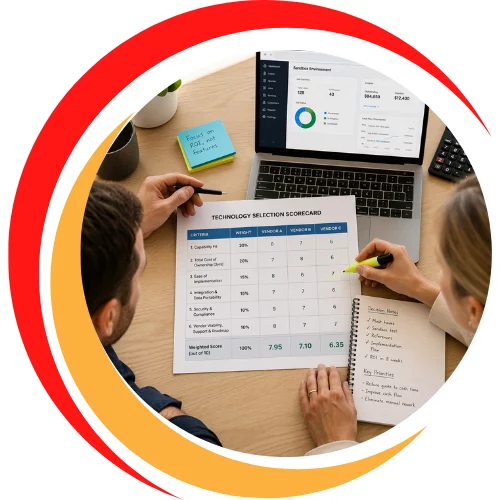
Put structure around selection. Use a simple, weighted framework that your team can score in one meeting.
Recommended criteria and weights:
- Core capability fit, 30%
- Total cost of ownership over three years, 20%
- Ease of implementation, 15%
- Integration and data portability, 15%
- Security and compliance posture, 10%
- Vendor viability, service and roadmap, 10%
How to apply it:
- Translate process needs into five to eight “must haves”.
- Score each vendor against those must-haves, not marketing features.
- Run a short sandbox with real data to test speed and reliability.
- Document compromises and workarounds before you buy.
This keeps digital transformation for SMEs anchored to value, not feature lists. It also helps you defend decisions to a board, a lender, or an insurer. The same framework supports renewal and renegotiation. If a tool no longer meets core needs, the scoring will show it.
Two practical notes:
- Most small firms gain more by adopting proven tools than by building from scratch. That speeds delivery and lowers risk. This is a hallmark of successful digital transformation for SMEs.
- Treat security controls as non-negotiable. Use multi-factor authentication, role permissions and backups as a minimum. When security is baked into the design, digital transformation for SMEs protects both cash flow and data.
Implementation planning and pilots
A strong plan is short and visible. Treat it like any other operational project.
Build a four-stage plan:
- Pilot, four to six weeks. Prove the flow with a single process, a single team, and real data.
- Stabilise. Fix defects, tune settings, finalise SOPs and checklists.
- Scale. Roll out to the next team or site with lessons learned.
- Optimise. Use reports to refine steps and remove waste.
Pilot design tips:
- Keep scope tight. Limit to one or two KPIs.
- Assign a product owner from the business, not IT.
- Include one resistor. They surface real risks early.
- Write the change story. Explain what improves, for whom, and when.
This is where digital transformation for SMEs earns trust. A good pilot reduces risk, builds internal champions and confirms the business case before wider rollout. Capture the before and after. Share the numbers in plain language. When leaders and staff can see improvements in speed, accuracy, and cash flow, momentum builds. That is the engine of sustainable digital transformation for SMEs.
Measuring ROI and adoption
What you measure improves. Link benefits to the process you changed.
Pick three types of measures:
- Time to cash. Days from quote to invoice, and invoice to banked cash.
- Productivity. Hours per task, jobs per day, and orders per full-time equivalent.
- Quality and risk. Error rates, rework, chargebacks, and audit flags.
Build a benefits register:
- Baseline each metric for four weeks.
- Forecast the target state.
- Assign an owner and a review date.
- Track monthly and publish results.
Adoption signals:
- Logins per user per week
- Share of tasks completed in the new system
- Number of help requests and the time to close
- User satisfaction pulse scores
Good measurement keeps digital transformation for SMEs honest. It also supports finance, tax and grant reporting. Most of all, it speeds future approvals. When an early project shows real returns, the next step is easier to fund. Continuous reporting turns digital transformation for SMEs into a repeatable capability.
Training and support beyond go-live
Adoption does not end at go-live. Invest in capability and reinforcement.
What works:
- Role-based learning paths, short and practical
- Job aids, brief videos and searchable SOPs
- “Show me” sessions every fortnight for eight weeks
- Office hours with a named expert
- Micro-surveys to spot friction
- Refresher sessions at 30, 60 and 120 days
Supporting digital transformation for SMEs means tying training to real tasks. Staff need to know what to do on Monday morning, not just why the system is better.
Link training to people systems:
- Update position descriptions to include new accountabilities
- Align performance standards and incentives with the new process
- Capture lessons and feed them into the next release
Where helpful, bring in external help:
- Actually Supported Business Coaching for owner and manager cadence: https://sbaas.com.au/consulting-services/actually-supported-business-coaching-australia/
- HR and IR Services for role design and performance standards: https://sbaas.com.au/consulting-services/hr-ir-services/
- Training for manager capability and staff enablement: https://sbaas.com.au/consulting-services/training/
- Strategy to align decision rights and goals: https://sbaas.com.au/consulting-services/strategy/
- Governance and Risk for escalation and accountability: https://sbaas.com.au/consulting-services/governance-risk/
- These supports keep digital transformation for SMEs delivering benefits long after the project team steps away.
Practical roadmaps that pay back
Use this three-month outline to move from idea to impact.
Month 1, Diagnose and design
- Confirm business goals and target KPIs
- Map the current process and remove waste
- Define must-have requirements and shortlist tools
- Build the benefits register and project plan
Month 2, Pilot and stabilise
- Configure the tool in a sandbox with real data
- Train the pilot team and run the process for four weeks
- Fix defects, document SOPs and change controls
- Report pilot metrics and decide on rollout
Month 3, Scale and embed
- Roll out to the next team or site
- Enable role-based training and support
- Monitor adoption and ROI monthly
- Close the project and hand over to the owners
This staged approach makes digital transformation for SMEs manageable. It front-loads value, reduces risk, and builds momentum. The pattern is simple. Pick a flow. Prove it. Scale it. Improve it. Then repeat. Over time, digital transformation for SMEs becomes part of how your business runs.
Tool comparison checklist for busy owners
When time is short, use this single-page checklist.
- Problem statement, written in one sentence
- Measurable goal, with a target date
- Five must-have capabilities
- Three nice-to-haves
- Three-year total cost of ownership
- Integration points and data ownership plan
- Security and privacy controls
- Implementation time and who will own it
- Training plan and support model
- Exit plan if the tool fails to deliver
A clear checklist keeps SMEs’ digital transformation grounded in outcomes. It prevents decision drift and speeds up vendor meetings.
Finance, funding and risk notes for Australia
- Cash is king. Choose projects that reduce working capital days or cut errors that delay cash. Digital transformation for SMEs performs best when it targets the order-to-cash path first.
- When you negotiate with vendors, consider consumption pricing. Pay for usage, not shelfware. That improves ROI for digital transformation for SMEs.
- Raise your security posture during change. Add multi-factor authentication, backups, and regular permission reviews. Combine security uplift with every release. That habit will protect SMEs’ gains from digital transformation.
- Keep documentation short and searchable. Use one source of truth for SOPs. Build a short video library. Clarity is a force multiplier for digital transformation for SMEs.
FAQ
What is a sensible first automation for a small business?
Start with quote-to-invoice or timesheets-to-payroll. These flows are high-frequency, measurable and visible. They reduce days to cash and owner time. They also build trust in digital transformation among SMEs by demonstrating quick gains. Once a small win lands, expand to dispatch, inventory or service updates.
How do I objectively compare vendor tools?
Write must-have capabilities linked to your process. Weight criteria like capability fit, total cost over three years, ease of setup, integration, security and vendor viability. Score each option with real data in a sandbox and document trade-offs. This keeps digital transformation for SMEs aligned to outcomes, not features.
How should we measure ROI?
Track time saved, error reduction and faster cash. Use a benefits register with baselines and owners. Report monthly. Include adoption metrics such as logins, completion rates and help requests. Present results in a one-page dashboard. That is how digital transformation for SMEs secures support for the next phase.
The bottom line
Good digital transformation for SMEs is not a technology story. It is an operations story with a balance sheet ending. Fix the flow, then select the tool. Prove the value in a pilot. Train people on the job and keep measuring. Repeat.
If you want help to translate this into a 90-day plan, we can partner with you. Book an appointment or learn more about us on our About Us page.
Service links
- Actually Supported Business Coaching: owner and manager coaching
https://sbaas.com.au/consulting-services/actually-supported-business-coaching-australia/ - HR and IR Services: role design and performance standards
https://sbaas.com.au/consulting-services/hr-ir-services/ - Training: manager capability development
https://sbaas.com.au/consulting-services/training/ - Strategy: decision rights aligned to goals
https://sbaas.com.au/consulting-services/strategy/ - Governance and Risk: escalation and accountability
https://sbaas.com.au/consulting-services/governance-risk/
Sources
Australian Bureau of Statistics, Counts of Australian Businesses, including Entries and Exits. https://www.abs.gov.au/statistics/economy/business-indicators/counts-australian-businesses-including-entries-and-exits/latest-release
Australian Bureau of Statistics, Business Indicators. https://www.abs.gov.au/statistics/economy/business-indicators
Australian Small Business and Family Enterprise Ombudsman, Number of Small Businesses in Australia. https://www.asbfeo.gov.au/small-business-data-portal/number-small-businesses-australia
Digital Transformation Agency, Major Digital Projects Report 2025. https://www.digital.gov.au/sites/default/files/documents/2025-03/2025%20Major%20Digital%20Projects%20Report.pdf
Digital Transformation Agency, Annual Report 2023–24. https://www.dta.gov.au/articles/dtas-annual-report-2023-24
Reserve Bank of Australia, Adoption of Emerging Digital General-purpose Technologies
Eric Allgood is the Managing Director of SBAAS and brings over two decades of experience in corporate guidance, with a focus on governance and risk, crisis management, industrial relations, and sustainability.
He founded SBAAS in 2019 to extend his corporate strategies to small businesses, quickly becoming a vital support. His background in IR, governance and risk management, combined with his crisis management skills, has enabled businesses to navigate challenges effectively.
Eric’s commitment to sustainability shapes his approach to fostering inclusive and ethical practices within organisations. His strategic acumen and dedication to sustainable growth have positioned SBAAS as a leader in supporting small businesses through integrity and resilience.
Qualifications:
- Master of Business Law
- MBA (USA)
- Graduate Certificate of Business Administration
- Graduate Certificate of Training and Development
- Diploma of Psychology (University of Warwickshire)
- Bachelor of Applied Management
Memberships:
- Small Business Association of Australia –
International Think Tank Member and Sponsor - Australian Institute of Company Directors – MAICD
- Institute of Community Directors Australia – ICDA
- Australian Human Resource Institute – CAHRI
Our Consulting Services
Management Consulting

Compliance & Risk
Professional Writing Services
Consistency in Communication
Small Business Consulting
Sustainable Businesses
Start-ups
Set-up for Success
Further Reading

Stop Waiting for Perfect: How Australian SMEs Win by Embracing Imperfection in Strategy
Small businesses do not need perfect plans to grow. They need to embrace imperfection in strategy, make small reversible bets, and learn fast. This practical playbook shows how Australian SMEs can move with confidence, reduce waste, and create value in any market.

The Monoculture Myth: Loud Words, No Policy, and a Bill Your Business Pays
Over 60 per cent of Australian small businesses fail within three years. The common thread? They never sought external advice. Understanding what a business consultant actually does could be the difference between thriving and closing the doors.

Why Marketing Consulting Moves the Needle for Australian SMEs: Strategy Over Tactics
Small businesses in Australia often fall prey to short-term marketing tactics that drain budgets and deliver little return. This article explores how working with a marketing consultant shifts the focus from fleeting campaigns to strategic, sustainable growth. Learn what a marketing consultant does for SMEs and how to avoid common pitfalls that hold businesses back.

There Are Only Four Ways to Grow a Small Business. Most Owners Pull Just One and Wonder Why It Is So Hard
Growing a business feels like a thousand possible tactics. It is not. There are only four levers that actually grow a small business, and most owners pull only the hardest and most expensive one. Here are all four, how they multiply together, and how to pull them without burning out.

Allied health policies and procedures your practice needs for compliance
Allied health policies and procedures your practice needs for compliance An NDIS audit gets booked for six weeks out, and the practice manager opens the

When should you engage a professional policy and procedure writer?
Australian businesses are feeling the squeeze. Costs rise, talent is tight, and customers expect speed. This practical blueprint shows how process improvement consulting maps your work, removes bottlenecks, and lifts throughput, all without adding headcount.