
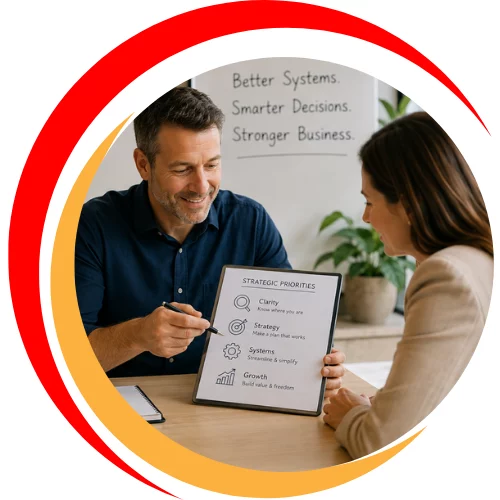


Is It Time to Hire a Business Consultant? 5 Spot-On Signs You’re Ready to Grow
Small businesses in Australia operate in environments characterised by rapid change, resource constraints, and global competition. Recognising when engaging a business consultant is essential for maintaining competitiveness, improving efficiency, and supporting sustainable growth. This article presents five analytical indicators that signal the need for consulting expertise.
1. Growth Has Plateaued or Is Declining
When revenues plateau or decline with no obvious internal explanation, this indicates strategic stagnation or operational inefficiency. A business consultant can conduct systematic diagnostics, identify critical barriers, and develop a revitalised growth strategy. External insight is often essential to detecting and unlocking new opportunities.
2. Operational Inefficiencies Are Holding You Back
Internal optimisation efforts may have reached their limits if processes frequently result in delays, resource waste, or bottlenecks. Consultants offer structured analysis and redesign of workflows to enhance productivity. They bring specialised operational methodologies that internal teams may lack.
3. You Lack Clarity on What Is or Isn’t Working
Operating on intuition alone can lead to misallocated efforts and unclear outcomes. A business consultant introduces data-driven frameworks to measure performance, assess return on investment, and prioritise high-impact activities. This analytical clarity transforms reactive decisions into strategic intent.
4. Major Transitions Are Approaching
Whether launching a new location, pivoting your product offering, or entering external markets, transitions carry elevated risk. A consultant provides planning structures, risk assessments, and implementation frameworks that increase the probability of successful execution relative to internal efforts alone.
5. Team Structure and Culture Are Failing You
High turnover, poor morale, and unclear roles reduce organisational effectiveness. Consultants conduct systematic assessments of structure and culture and design interventions such as clarifying responsibilities, standardising procedures, and improving communication channels. These measures support team resilience and enhanced performance.
Summary
Business Condition | Analytical Requirement | Consultant Contribution |
Plateauing or falling growth | Strategic diagnosis and targeted solutions | Objective analysis and growth roadmap |
Operational inefficiency | Process audit and workflow optimisation | Expert redesign of operations |
Lack of clarity on performance | Metrics development and ROI analysis | Data-driven prioritisation |
Approaching major transitions | Risk evaluation and structured planning | Change management framework |
Team dysfunction and morale issues | Organisational design and culture enhancement | Role clarity, SOPs, team alignment |
Relevance to Australian Businesses
Australian SMEs face high operational costs, tight regulatory environments, and limited internal capacity. Engaging a business consultant offers an efficient, flexible, and scalable mechanism to access specialised skills without permanent overhead. Timely engagement can yield operational efficiencies, strategic alignment, and measurable performance improvements within a short timeframe.
Final Word
The decision to work with a business consultant should stem from observable business conditions, not intuition or peer pressure. When growth stalls, operations drag, clarity fades, significant changes loom, or the team struggles, external expertise becomes a strategic necessity. Consultants deliver rigorous diagnosis, structured solutions, and focused execution, enabling your business to evolve, adapt, and thrive.
Sources
When is the Right Time to Hire a Business Consultant? (https://boardroomadvisors.co/signs-you-need-to-hire-a-business-consultant/)
Should You Hire a Consultant? How to Know When It’s Time to Get Professional Help for Your Business (https://www.smallbizmighty.com/post/how-to-know-when-it-s-time-to-hire-a-consultant)
When to Hire a Business Consultant? – HiThrive (https://www.hithrive.co/blog/when-should-you-hire-a-business-consultant)
When Should You Hire a Business Consultant? (https://workdash.com.au/when-to-hire-a-business-consultant/)
10 Signs You Need to Hire a Business Consultant (https://at-hiq.com/signs-you-need-to-hire-a-business-consultant)
Eric Allgood is the Managing Director of SBAAS and brings over two decades of experience in corporate guidance, with a focus on governance and risk, crisis management, industrial relations, and sustainability.
He founded SBAAS in 2019 to extend his corporate strategies to small businesses, quickly becoming a vital support. His background in IR, governance and risk management, combined with his crisis management skills, has enabled businesses to navigate challenges effectively.
Eric’s commitment to sustainability shapes his approach to fostering inclusive and ethical practices within organisations. His strategic acumen and dedication to sustainable growth have positioned SBAAS as a leader in supporting small businesses through integrity and resilience.
Qualifications:
- Master of Business Law
- MBA (USA)
- Graduate Certificate of Business Administration
- Graduate Certificate of Training and Development
- Diploma of Psychology (University of Warwickshire)
- Bachelor of Applied Management
Memberships:
- Small Business Association of Australia –
International Think Tank Member and Sponsor - Australian Institute of Company Directors – MAICD
- Institute of Community Directors Australia – ICDA
- Australian Human Resource Institute – CAHRI
Our Consulting Services
Management Consulting

Compliance & Risk
Professional Writing Services
Consistency in Communication
Small Business Consulting
Sustainable Businesses
Start-ups
Set-up for Success
Further Reading

Is Business Coaching Really Worth It? Here’s What Every Aussie SME Needs to Know
Business coaching is no longer a luxury—it’s a strategy. This article explores the tangible returns and real-world results Australian SMEs see from business coaching in today’s climate.

Since 1 August, Every Childcare Service Has a Written Duty to Children With Disability. Most Have Not Read It.
On 1 August 2026, the Disability Standards for Education 2005 were extended to almost every early childhood service in Australia: long day care, family day care, in-home care, outside school hours and vacation care. The obligations under the Disability Discrimination Act were always there. What has changed is that they are now spelled out, auditable, and enforceable in a form that families and regulators can point to. Here is what the Standards require, what a reasonable adjustment actually is, and what to put in place now.
Your Next Patient May Never See a List. An AI Will Choose for Them.
More and more buying decisions are being made by AI, not people. For allied health practices, that shift may soon influence how patients discover, compare and book healthcare services. As AI agents become the gatekeepers of search and selection, practices with accurate, consistent and easily accessible information will be the ones most likely to be recommended. The good news? The same factual, transparent approach that AI rewards is also aligned with AHPRA’s advertising requirements.

Most Small Businesses Now Own AI. Almost None Use It Well. Here Is How to Be the Exception.
Most small businesses now use some form of AI. Very few get real value from it. Agentic AI changes that by moving beyond simple prompts and handling multi-step tasks, but the advantage does not come from owning more tools. It comes from choosing one useful workflow, keeping a person accountable, measuring the result, and building from what works.

The Price of Getting It Wrong Just Doubled
In March 2026, the maximum penalties under the Australian Consumer Law doubled overnight. You will probably never face the top fine. So why should a small business owner care? Because the change quietly raised the stakes on the everyday decisions you already make, from the quote you send tomorrow to the refund you handle next week.

Seven in Ten Change Efforts Fail. The Problem Is Rarely the Plan.
Most change efforts fail, and almost never because of the plan. They fail on people. Leading change well means giving people a compelling why, modelling the change yourself, bringing your team and clients with you, and following through long after launch. Get that right, and change becomes the thing that pulls your business ahead, not the thing that breaks it.