Your Next Patient May Never See a List. An AI Will Choose for Them.

A growing share of decisions is made by AI, not people. For an allied health practice, an AI agent may soon choose your patients’ next practitioner. Here is how to be the one it picks, within the rules that bind health advertising.

Business 1 3 2

More and more buying decisions are being made by AI, not people. Customers now ask an assistant to find, compare, and even book a service, then act on its answer.

This is heading for allied health. An AI agent may soon choose your patients’ next practitioner, working from clear criteria: location, availability, services, fees, fund and Medicare details, and registration.

To be chosen, your practice needs accurate, consistent facts in every place an AI agent looks. The good news is that AI agents reward substance over slogans. Get the facts right and you are in the running.

One thing sets health apart. You must do all of this within AHPRA’s advertising rules, which limit testimonials and outcome claims. So you compete on verifiable facts and genuine care, not hype, which is exactly what an AI agent rewards anyway.

If you take one thing from this article, take these four moves

  • Keep your core facts accurate and identical everywhere: services, location, hours, fees, fund and Medicare details, registration.
  • Make booking easy, with your real-time availability visible online.
  • Build trust through clear, factual information, within AHPRA’s rules.
  • Keep a person in charge of the care and relationship an AI cannot replace.

Everything below is optional depth. Read on if you want the evidence, the local picture, and the practical detail, including where health rules change the playbook.

Digging Deeper

Below sits the supporting case. It covers what is changing, why allied health is closer to it than it looks, how AI agents decide, and the compliance twist that sets health apart.

What “the buyer is not a person” actually means

For decades, marketing aimed at a human. You earned attention, and a person decided. That order is starting to change.

McKinsey describes a shift from attention to action. AI agents now discover options, compare them, and increasingly complete the task, with limited human input. More than half of advertisers already say AI has reshaped how customers find and consider them.

In retail, this is called agentic commerce. AI agents rank products, assemble baskets, and check out on the buyer’s behalf. McKinsey is blunt that a meaningful share of customers will soon not be human users at all, but AI agents acting for them.

The same logic reaches services. For your practice, the AI agent becomes the gatekeeper. It decides who is shown, who is shortlisted, and who is booked, often before a person reads a single listing.

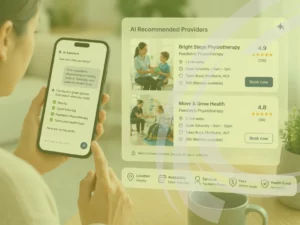
Picture a parent asking an assistant to find a paediatric physiotherapist nearby, open on Saturday, who takes their health fund. The assistant returns one or two names and offers to book. No list. No scrolling. The choice is largely made before the parent reads a word.

Why allied health is closer to this than it looks

This may sound futuristic. In allied health, the groundwork is already laid.

Australians routinely find and book practitioners through criteria-based platforms. Healthengine recently passed 100 million bookings, and handles around a million each month, with usage up more than 30 per cent in a year. Nearly one in three Australians use HotDoc to find and book care.

On these platforms, patients already filter by location, services, fees and bulk billing, availability, practitioner gender, language, and telehealth. That is structured, criteria-based choosing, which is exactly how an AI agent works.

So the leap is small. An AI agent doing that filtering and booking for the patient is the next step, not science fiction. Google’s AI Mode, which can already act on a user’s behalf, reached Australia in late 2025.

How an AI agent decides who to put forward

AI agents do not respond to clever marketing. They respond to facts that match a request. That changes what matters.

For a practice, an AI agent weighs concrete, checkable details:

  • Location and the areas you serve, including telehealth.
  • The specific services and conditions you treat.
  • Real-time availability and how easily a patient can book.
  • Fees, bulk billing, and any gap costs.
  • Health fund, Medicare, and NDIS acceptance.
  • Registration, qualifications, languages, and accessibility.

The practice with clear, complete, consistent facts is the one an AI agent can confidently present. Gaps and contradictions get filtered out. This rewards substance. An agent cannot be charmed, only matched.

Consistency matters as much as completeness. If your fees, hours, or services differ across your website, your booking platform, and a directory, an AI agent cannot tell which is true. Mixed signals get you passed over.

The health twist: you cannot market like a tradie

Here is where allied health differs sharply from other businesses. Your advertising is tightly regulated.

Under AHPRA’s advertising rules, a regulated health service must not use testimonials about the clinical aspects of care. It must not be misleading, and it must not create an unreasonable expectation of benefit.

In practice, you cannot chase and showcase clinical reviews the way a tradie chases Google reviews. You can show an overall star rating and link your profile. You cannot feature individual reviews that mention symptoms, treatments, or outcomes on channels you control.

You also cannot overclaim. Avoid words like best or guaranteed. Do not use the title specialist unless you hold that registration. Do not publish AI-generated images that imply a treatment result. Breaches are a criminal offence and can carry significant penalties.

The upside is real. AI agents reward exactly what AHPRA requires: accurate, factual, verifiable information. Play it straight, and you are both compliant and agent-ready. This is general information, not legal advice, so check AHPRA’s guidelines for your profession.

What to get right now

You do not need to predict the future to prepare for it. You need your facts in order, in the places patients and AI agents already look.

Focus here first:

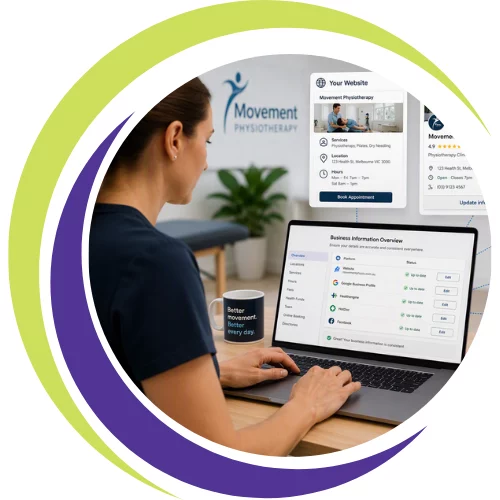
  • Complete, identical listings across your website, Google Business Profile, booking platforms, and directories.
  • Clear service and condition pages, written in plain language.
  • Real-time online booking that is simple to use.
  • Accurate fees, fund, Medicare, and NDIS information.
  • Correct registration details and titles, with no overclaiming.

Notice the pattern. The same facts that help a patient choose you also help an AI agent choose you. You are not doing two jobs. You are doing one job properly.

Keep the human where it counts

There is a limit to what an AI agent does, and it matters. An agent can find and book the appointment. It cannot deliver the care.

So do not optimise away the relationship. The AI agent gets a patient through the door once. The experience in the room decides whether they stay, return, and refer. A patient who feels genuinely cared for becomes a loyal one, and still tells friends and family, whatever an AI suggested.

Keep a person accountable for accuracy and for how the practice is represented online. The technology earns the first visit. Your people earn every one after that.

What to ignore, and how to start

You will be offered services that promise to make AI agents rank you first. Treat those claims with caution. No one controls how AI agents choose, and health adds rules that others ignore at their peril.

Start small instead. Get your facts accurate and consistent in the three or four places patients and AI agents already look. Once a month, ask an AI assistant to find a practice like yours, and see whether you appear and how you are described.

Be honest about the unknowns, too. This shift is early, and the tools change often. Accurate facts, easy booking, and good care are the bets that hold their value.

Where to from here

The rise of AI agents is not a reason to panic. It is a reason to get the fundamentals right, a little ahead of the curve.

Make your facts accurate and consistent. Make booking easy. Stay within the rules. Keep your people at the centre of the care. Do that, and whether the next patient is chosen by a person or by an AI agent, your practice is ready to be picked.

If you would like help getting your practice ready for how patients and AI agents now choose, SBAAS can guide you through it, compliance included. We help Australian allied health practices and small businesses build accurate, consistent, and rule-aware foundations. To learn more about how we work, visit https://sbaas.com.au/about-us/ or call (07) 3916 9896 to talk it through.

Sources

Australian Health Practitioner Regulation Agency. (2025). Guidelines for advertising a regulated health service. https://www.ahpra.gov.au/Resources/Advertising-hub/Advertising-guidelines-and-other-guidance/Advertising-guidelines.aspx

Google Australia. (2025). Introducing AI Mode in Australia. https://blog.google/intl/en-au/products/explore-get-answers/ai-mode-in-australia/

Healthengine. (2025). Healthengine surpasses 100 million bookings. https://healthengine.com.au/press/2025/11/18/healthengine-surpasses-100-million-bookings-marking-100-million-moments-of-australians-getting-the-care-they-need/

HotDoc. (2025). Find and book your doctor online. https://www.hotdoc.com.au/

McKinsey & Company. (2025). The agentic commerce opportunity: How AI agents are ushering in a new era for consumers and merchants. https://www.mckinsey.com/capabilities/quantumblack/our-insights/the-agentic-commerce-opportunity-how-ai-agents-are-ushering-in-a-new-era-for-consumers-and-merchants

McKinsey & Company. (2026). The agentic advertising economy: From attention to action. https://www.mckinsey.com/industries/technology-media-and-telecommunications/our-insights/the-agentic-advertising-economy-from-attention-to-action

0d9a8782 branding profiles

Eric Allgood is the Managing Director of SBAAS and brings over two decades of experience in corporate guidance, with a focus on governance and risk, crisis management, industrial relations, and sustainability.

He founded SBAAS in 2019 to extend his corporate strategies to small businesses, quickly becoming a vital support. His background in IR, governance and risk management, combined with his crisis management skills, has enabled businesses to navigate challenges effectively.

Eric’s commitment to sustainability shapes his approach to fostering inclusive and ethical practices within organisations. His strategic acumen and dedication to sustainable growth have positioned SBAAS as a leader in supporting small businesses through integrity and resilience.

Qualifications:

  • Master of Business Law
  • MBA (USA)
  • Graduate Certificate of Business Administration
  • Graduate Certificate of Training and Development
  • Diploma of Psychology (University of Warwickshire)
  • Bachelor of Applied Management

Memberships:

  • Small Business Association of Australia –
    International Think Tank Member and Sponsor
  • Australian Institute of Company Directors – MAICD
  • Institute of Community Directors Australia – ICDA
  • Australian Human Resource Institute – CAHRI

Our Consulting Services

Management Consulting

For larger companies, SBAAS transforms complexity into clarity with solutions that accelerate performance, growth and market resilience.

Compliance & Risk

From enterprise agreements to governance frameworks, SBAAS ensures compliance, reduces exposure and supports sustainable, risk-aware decision-making.
Learn more
sbaas financial management

Professional Writing Services

Content that elevates your message, builds credibility & drives impact across tenders, reports, policies and executive communications.

Consistency in Communication

Clear, plain-English documents that meet compliance standards, reduce risk, and protect reputation through accurate, accessible and professional communication.
Learn more

Small Business Consulting

For small businesses, tailored strategies in marketing, operations & growth that boost profitability and strengthen customer connections.

Sustainable Businesses

Expert guidance in compliance, HR, policies and financial systems that reduce risks and create a secure foundation for sustainable expansion.
Learn more

Start-ups

For start-ups, SBAAS provides everything needed to launch, from setting up your books to building websites and driving growth strategies.

Set-up for Success

From compliance requirements to business structure, SBAAS ensures new ventures start strong, minimise risks and build systems for lasting success.
Learn more

Further Reading

When ai agents choose

Your Next Patient May Never See a List. An AI Will Choose for Them.

More and more buying decisions are being made by AI, not people. For allied health practices, that shift may soon influence how patients discover, compare and book healthcare services. As AI agents become the gatekeepers of search and selection, practices with accurate, consistent and easily accessible information will be the ones most likely to be recommended. The good news? The same factual, transparent approach that AI rewards is also aligned with AHPRA’s advertising requirements.

Read More »
Consumer law penalties

The Price of Getting It Wrong Just Doubled

In March 2026, the maximum penalties under the Australian Consumer Law doubled overnight. You will probably never face the top fine. So why should a small business owner care? Because the change quietly raised the stakes on the everyday decisions you already make, from the quote you send tomorrow to the refund you handle next week.

Read More »
Leading change

Seven in Ten Change Efforts Fail. The Problem Is Rarely the Plan.

Most change efforts fail, and almost never because of the plan. They fail on people. Leading change well means giving people a compelling why, modelling the change yourself, bringing your team and clients with you, and following through long after launch. Get that right, and change becomes the thing that pulls your business ahead, not the thing that breaks it.

Read More »
Hidden fees

Hidden Fees Just Became a Very Bad Idea

You advertise a price. The customer reaches the end, and the total has grown: a booking fee here, a card surcharge there. It feels harmless. It is not. Hiding compulsory fees until checkout is against the law; regulators are fining businesses for it, and a change set to land in October 2026 is about to make surprise fees riskier than ever.

Read More »

SBAAS Events

Add Your Heading Text Here

Skip to content