Digging Deeper
Below sits the supporting case. It covers what is changing, why allied health is closer to it than it looks, how AI agents decide, and the compliance twist that sets health apart.
What “the buyer is not a person” actually means
For decades, marketing aimed at a human. You earned attention, and a person decided. That order is starting to change.
McKinsey describes a shift from attention to action. AI agents now discover options, compare them, and increasingly complete the task, with limited human input. More than half of advertisers already say AI has reshaped how customers find and consider them.
In retail, this is called agentic commerce. AI agents rank products, assemble baskets, and check out on the buyer’s behalf. McKinsey is blunt that a meaningful share of customers will soon not be human users at all, but AI agents acting for them.
The same logic reaches services. For your practice, the AI agent becomes the gatekeeper. It decides who is shown, who is shortlisted, and who is booked, often before a person reads a single listing.
Picture a parent asking an assistant to find a paediatric physiotherapist nearby, open on Saturday, who takes their health fund. The assistant returns one or two names and offers to book. No list. No scrolling. The choice is largely made before the parent reads a word.
Why allied health is closer to this than it looks
This may sound futuristic. In allied health, the groundwork is already laid.
Australians routinely find and book practitioners through criteria-based platforms. Healthengine recently passed 100 million bookings, and handles around a million each month, with usage up more than 30 per cent in a year. Nearly one in three Australians use HotDoc to find and book care.
On these platforms, patients already filter by location, services, fees and bulk billing, availability, practitioner gender, language, and telehealth. That is structured, criteria-based choosing, which is exactly how an AI agent works.
So the leap is small. An AI agent doing that filtering and booking for the patient is the next step, not science fiction. Google’s AI Mode, which can already act on a user’s behalf, reached Australia in late 2025.
How an AI agent decides who to put forward
AI agents do not respond to clever marketing. They respond to facts that match a request. That changes what matters.
For a practice, an AI agent weighs concrete, checkable details:
- Location and the areas you serve, including telehealth.
- The specific services and conditions you treat.
- Real-time availability and how easily a patient can book.
- Fees, bulk billing, and any gap costs.
- Health fund, Medicare, and NDIS acceptance.
- Registration, qualifications, languages, and accessibility.
The practice with clear, complete, consistent facts is the one an AI agent can confidently present. Gaps and contradictions get filtered out. This rewards substance. An agent cannot be charmed, only matched.
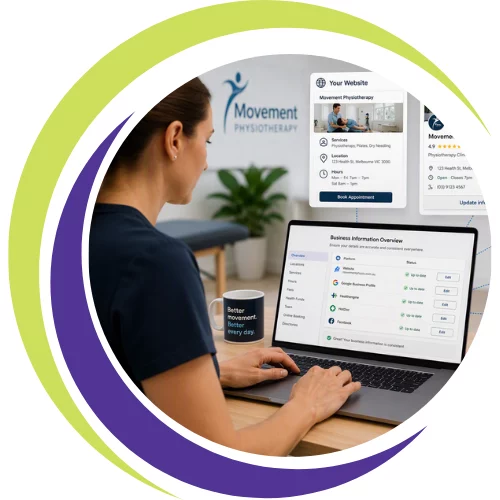
Consistency matters as much as completeness. If your fees, hours, or services differ across your website, your booking platform, and a directory, an AI agent cannot tell which is true. Mixed signals get you passed over.
The health twist: you cannot market like a tradie
Here is where allied health differs sharply from other businesses. Your advertising is tightly regulated.
Under AHPRA’s advertising rules, a regulated health service must not use testimonials about the clinical aspects of care. It must not be misleading, and it must not create an unreasonable expectation of benefit.
In practice, you cannot chase and showcase clinical reviews the way a tradie chases Google reviews. You can show an overall star rating and link your profile. You cannot feature individual reviews that mention symptoms, treatments, or outcomes on channels you control.
You also cannot overclaim. Avoid words like best or guaranteed. Do not use the title specialist unless you hold that registration. Do not publish AI-generated images that imply a treatment result. Breaches are a criminal offence and can carry significant penalties.
The upside is real. AI agents reward exactly what AHPRA requires: accurate, factual, verifiable information. Play it straight, and you are both compliant and agent-ready. This is general information, not legal advice, so check AHPRA’s guidelines for your profession.
What to get right now
You do not need to predict the future to prepare for it. You need your facts in order, in the places patients and AI agents already look.
Focus here first:
- Complete, identical listings across your website, Google Business Profile, booking platforms, and directories.
- Clear service and condition pages, written in plain language.
- Real-time online booking that is simple to use.
- Accurate fees, fund, Medicare, and NDIS information.
- Correct registration details and titles, with no overclaiming.
Notice the pattern. The same facts that help a patient choose you also help an AI agent choose you. You are not doing two jobs. You are doing one job properly.
Keep the human where it counts
There is a limit to what an AI agent does, and it matters. An agent can find and book the appointment. It cannot deliver the care.
So do not optimise away the relationship. The AI agent gets a patient through the door once. The experience in the room decides whether they stay, return, and refer. A patient who feels genuinely cared for becomes a loyal one, and still tells friends and family, whatever an AI suggested.
Keep a person accountable for accuracy and for how the practice is represented online. The technology earns the first visit. Your people earn every one after that.
What to ignore, and how to start
You will be offered services that promise to make AI agents rank you first. Treat those claims with caution. No one controls how AI agents choose, and health adds rules that others ignore at their peril.
Start small instead. Get your facts accurate and consistent in the three or four places patients and AI agents already look. Once a month, ask an AI assistant to find a practice like yours, and see whether you appear and how you are described.
Be honest about the unknowns, too. This shift is early, and the tools change often. Accurate facts, easy booking, and good care are the bets that hold their value.
Where to from here
The rise of AI agents is not a reason to panic. It is a reason to get the fundamentals right, a little ahead of the curve.
Make your facts accurate and consistent. Make booking easy. Stay within the rules. Keep your people at the centre of the care. Do that, and whether the next patient is chosen by a person or by an AI agent, your practice is ready to be picked.
If you would like help getting your practice ready for how patients and AI agents now choose, SBAAS can guide you through it, compliance included. We help Australian allied health practices and small businesses build accurate, consistent, and rule-aware foundations. To learn more about how we work, visit https://sbaas.com.au/about-us/ or call (07) 3916 9896 to talk it through.