
Exciting Businesses Fail. Boring Ones Get Paid.

Australian trade businesses rarely collapse because the owner had a bad idea. They collapse because nobody did the boring work. Construction now accounts for around 27 per cent of all company insolvencies in Australia, and the pattern behind those failures is identical whether a business turns over $180,000 or $40 million. Same four levers. Same failure points. Same three excuses. Here is what hundreds of engagements reveal about the boring business fundamentals that decide who survives.
If You Stopped Tomorrow, Would the Business Survive Without You?

Many owner-led businesses do not survive their founder’s exit because the knowledge, relationships and decisions all sit in one person’s head. Succession planning turns that fragile structure into a transferable business that can keep running, be sold, or be handed on when the owner steps away.
When Things Go Wrong, They Ask for the Policy You Never Wrote.

Professional policy and procedure writing turns Australia’s fast-changing rules into clear documents your team follows and a regulator accepts. Learn what a professional delivers, why it matters for allied health, trades, professional services and not-for-profits, and how to tell a real safeguard from a folder nobody reads.
Most Charities Now Use AI. The Ones That Thrive Won’t Lose Their People.

Two-thirds of Australian charities already use AI. Used well, it frees your staff and volunteers for the human work your cause runs on. Here is how to adopt AI for your not-for-profit without losing the people at its heart.
When Your Own Policy Becomes the Case Against You.

Write workplace policies and procedures that protect your business, not expose it. Learn the legal traps that turn a policy into a liability, the method to write clear and lawful documents, and what good looks like for professional services, trades, allied health and not-for-profits.
If AI Does the Junior Work, Where Will Your Senior Experts Come From?

AI now does the junior work your future experts once learned from. Discover how to build a human-AI workforce that keeps growing expertise, moves people to higher-value work, and meets your Fair Work obligations when roles change.
Everyone Says Gen Z Won’t Stick Around. Build the Right Workplace and They Will.

The story says Gen Z workers are flighty. The Australian data points to something more useful: many young workers leave because of the workplace, not the trade. Trust, support, fair treatment, clear expectations and purposeful work can turn retention into a competitive advantage.
Your Costs Rise on 1 July. Your Rebates Will Not. Inside the 2026 Minimum Wage Increase.

From the first full pay period on or after 1 July 2026, award wages rise 4.75 per cent and the National Minimum Wage passes $1,000 a week for the first time. For allied health practices, the cost lands straight away, while Medicare and NDIS rebates stay put. Here is what the minimum wage increase means, and what to do before your first July payday.
Your Team’s Mental Health Is Now a Legal Duty

Workplace mental health is no longer optional. Australian WHS laws require businesses to manage psychosocial hazards such as excessive workload, poor support, unclear roles, bullying, harassment and exposure to trauma. The duty applies to businesses of every size, and practical action starts with how work is designed.
Wellbeing Isn’t a Perk. It’s One of Your Biggest Business Numbers

Workforce wellbeing is not a soft extra. Mental ill-health costs the Australian economy up to $220 billion a year, while every dollar invested in a mentally healthy workplace returns about $2.30. Here is why wellbeing is a business number, and how small businesses across every sector can improve it.
Leadership Under Pressure: Decision Discipline for Volatile Markets
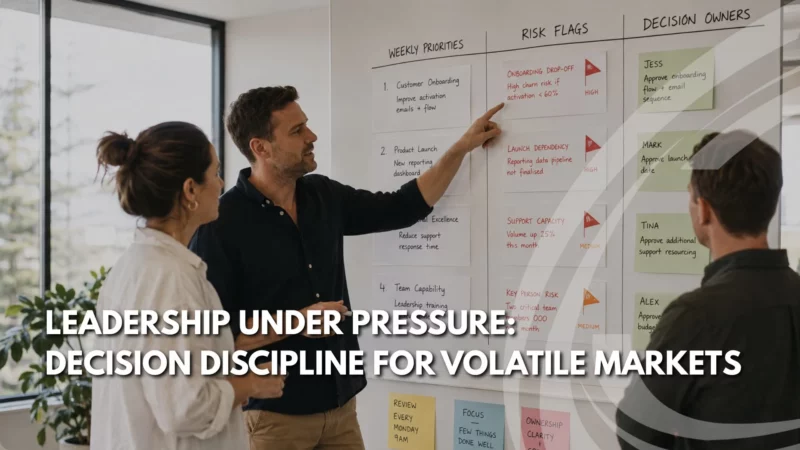
Australian businesses are operating through noise. This practical playbook shows owners how to use decision frameworks, firm delegation, and steady rhythms to protect margins and morale when the market moves fast.
The Hidden Cost of Success: How Leadership Burnout is Crippling Australia’s Small Business Sector
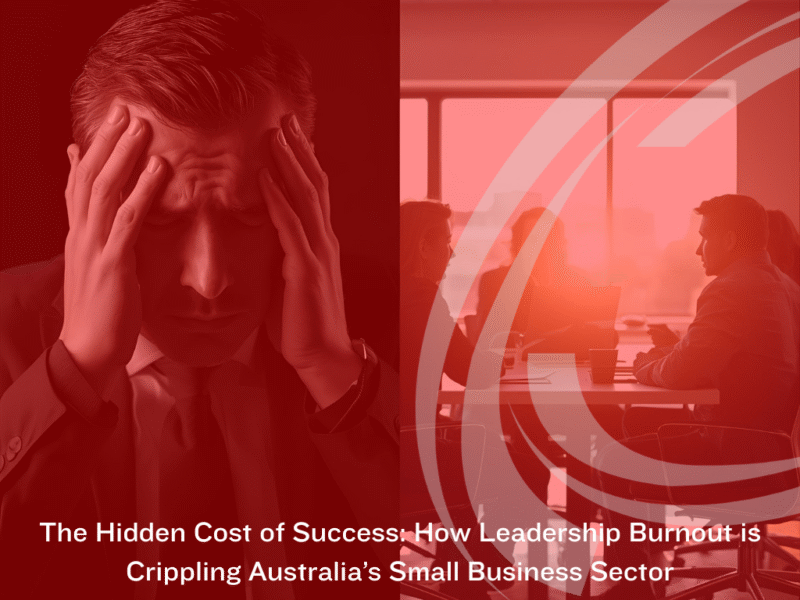
The Hidden Cost of Success What Is Leadership Burnout? Leadership burnout is more than just being tired. It’s a state of chronic physical, emotional, and mental exhaustion caused by prolonged stress and overwork. In the small business context, this can look like constant firefighting, blurred work-life boundaries, and the crushing weight of being “the one […]